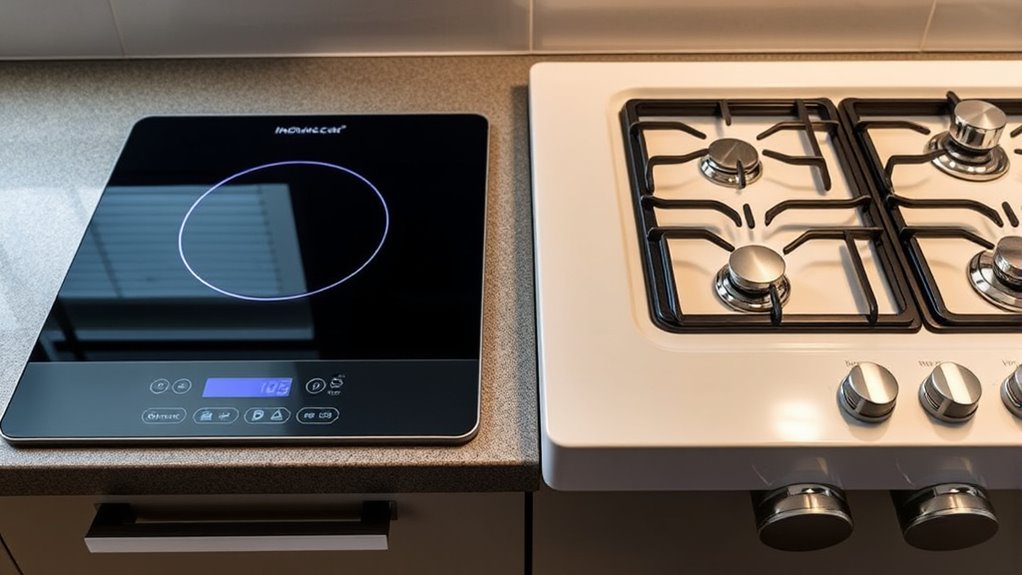
10 Key Differences Between Induction Cooker and Electric Stove
Are you tired of waiting forever for your stove to heat up or worried about safety when cooking? You’re not alone—many people struggle with choosing the right cooktop that fits their lifestyle and kitchen needs.
Induction cookers heat cookware directly with electromagnetic fields, making them faster, more energy-efficient, and safer due to cool surfaces and automatic shut-off features.
Electric stoves rely on resistive heating elements, take longer to heat, and can stay hot after use, increasing risk.
Induction requires compatible magnetic cookware and offers precise temperature control, while electric stoves work with more cookware types but have slower response times.
Keep exploring to uncover which option best suits your cooking style.
Key Takeaways
– Induction cookers heat cookware directly through electromagnetic fields. This means they respond faster and allow for more precise temperature control compared to electric stoves.
They heat up quickly, which can save you time in the kitchen. Plus, you get better control over the cooking process.
Induction surfaces stay cool to the touch, making them safer to use. Electric stoves, on the other hand, remain hot even after cooking, increasing the risk of burns.
You’ll need magnetic cookware to use an induction cooker. It’s also more compact and easier to store. Electric stoves work with all kinds of cookware and are usually bulkier.
In terms of efficiency, induction offers quicker heating and uses less energy. This can help reduce your electricity bills and cut down cooking time.
Electric stoves tend to be more affordable and are easier to install. They’re great for traditional cooking styles that require steady, long-duration heat.
How Do Induction Cookers and Electric Stoves Work?
Induction cookers and electric stoves work differently, even though both use electricity to generate heat.
An electric stove heats cookware through resistive heating elements that warm up when electricity flows through them. You place your pot or pan on the burner, and heat transfers directly from the element to the cookware.
Electric stoves transfer heat directly from heating elements to cookware, warming pots and pans through resistive heating.
In contrast, an induction cooker uses electromagnetic fields to directly heat ferromagnetic cookware. When you turn it on, an electric current creates a magnetic field, which induces heat inside the pan itself.
You’ll notice the surface stays relatively cool, with heat generated only in the cookware. This makes induction cooking faster and more responsive to temperature changes.
Electric stoves rely on heating elements that take longer to warm up and cool down, making them less quick to adjust.
Comparing Cooking Speed and Energy Efficiency
You’ll notice that induction cookers heat up faster than electric stoves, saving you time in the kitchen.
They also use energy more efficiently, which can help lower your utility bills.
Understanding these differences can help you choose the option that best fits your cooking habits.
Heating Speed Differences
While both induction cookers and electric stoves generate heat to cook your food, they differ significantly in how quickly they do so. Induction cookers heat faster because they directly transfer energy to the cookware through magnetic fields, reducing heat loss.
Electric stoves rely on heating elements that warm up gradually and transfer heat more slowly. This means you’ll notice quicker boiling and simmering with an induction unit. Here’s a quick comparison:
| Feature | Induction Cooker | Electric Stove |
|---|---|---|
| Heating Speed | Very fast | Moderate to slow |
| Heat Transfer Method | Magnetic induction | Electric heating elements |
| Response Time | Almost instantaneous | Delayed response |
Choose induction if you want speed, and electric for gradual heating.
Energy Consumption Variances
When comparing energy consumption between induction cookers and electric stoves, the efficiency of each appliance makes a big difference.
Induction cookers usually use less energy because they heat cookware directly through electromagnetic fields, which reduces heat loss. This means faster cooking times and lower electricity bills.
Electric stoves, on the other hand, heat via resistive elements that transfer heat to the cookware but lose more energy in the process.
As a result, they tend to use more power for the same cooking tasks.
If saving energy is your priority, induction cookers are a better choice. They heat up quickly and reduce overall energy use.
However, electric stoves might still work well if you don’t cook often or if you already have compatible cookware.
Are Induction Cookers Safer Than Electric Stoves?
Are induction cookers truly safer than electric stoves? Generally, induction cookers are considered safer because they heat cookware directly, which reduces the risk of burns from hot surfaces. They also turn off automatically when cookware is removed, helping prevent accidental fires.
Electric stoves, on the other hand, have hot coils or surfaces that stay hot even after turning off, which increases the risk of burns. Here’s a quick comparison:
| Feature | Induction Cooker | Electric Stove |
|---|---|---|
| Surface Temperature | Cool to touch when off | Remains hot after use |
| Auto Shut-off | Yes | No |
| Burn Risk | Lower | Higher |
| Safety Indicator Lights | Usually present | Sometimes absent |
| Fire Hazard | Less likely | More likely |
While induction cookers are generally safer, it’s always important to follow safety guidelines for any appliance.
Installation and Space Requirements for Each Appliance
Induction cookers usually need a flat, dedicated surface with enough space around for ventilation and heat to escape. If your kitchen has suitable countertops, their installation is pretty straightforward. They’re compact and portable, fitting easily on standard counters without special wiring.
They do require a nearby power outlet with a compatible circuit, typically 15-20 amps. Electric stoves, on the other hand, usually need a dedicated electrical connection—especially built-in ones—which might mean calling in a professional for installation.
Electric stoves tend to take up more space, whether as freestanding units or built-in appliances. They might also need extra room for airflow and ventilation. Both appliances need proper placement for safety and efficiency, but induction cookers are generally easier to install and move around.
Cost and Energy Consumption of Induction vs. Electric Stoves
While both induction cookers and electric stoves need electricity, induction cookers usually cost less to run over time because they’re more energy efficient. They heat cookware directly with magnetic energy, which cuts down on wasted heat.
This means they turn more electrical energy into cooking power, helping you save on your electricity bills. Electric stoves, on the other hand, heat the surface first, then transfer heat to the cookware, which causes energy loss.
Over time, induction cookers tend to be more economical because they heat up faster and cool down quickly once turned off. Even though they might cost more upfront, their lower energy use makes them more cost-effective in the long run.
If saving on energy bills is important to you, induction is the smarter choice.
Which Cooktop Looks Better and Is Easier to Keep Clean?
You’ll notice that induction cooktops often have a sleek, modern look, while electric stoves can vary in design.
Cleaning is usually easier on smooth, flat surfaces, but durability can differ between materials.
Thinking about these factors can help you pick a cooktop that looks good and is easy to keep clean.
Sleekness and Design
As far as sleekness and design are concerned, induction cooktops usually have a smooth, glass surface that gives a modern and minimalist look. It’s easy to blend into contemporary kitchens and creates a clean, uncluttered appearance that boosts your space’s aesthetic.
Their seamless design looks more polished and makes your kitchen feel more spacious and organized. Induction surfaces are also more durable, resisting scratches and stains better than traditional cooktops.
Electric stoves, on the other hand, often have coil burners or exposed heating elements, which can seem outdated and bulky. Overall, induction cooktops elevate your kitchen’s style with their sleek, streamlined appearance.
Ease of Cleaning
A smooth, flat surface makes cleaning a breeze, and induction cooktops excel in this area. Their glass-ceramic surfaces are seamless, so spills and splatters stay on top where you can easily wipe them away.
Since induction cooktops heat only the cookware, spills are less likely to burn onto the surface, which helps reduce stubborn stains. On the other hand, electric stoves with coil or coil-like burners have more crevices and textured surfaces, making cleaning more time-consuming.
You often need to scrub around burners or remove parts for thorough cleaning. With induction, a quick wipe with a damp cloth usually does the trick, keeping your cooktop looking spotless with minimal effort.
Surface Durability
Surface durability is key to how well a cooktop keeps its look over time. Induction cooktops usually have smooth glass surfaces that resist scratches and stains better when cleaned regularly, helping them stay looking new longer.
Electric stoves often have coil or coil-like surfaces that can chip, crack, or stain if you’re not careful. A durable surface means fewer repairs or replacements, saving you both time and money.
- Resistance to scratches and stains
- Easy cleaning of spills and splatters
- Ability to handle high temperatures
- Impact from accidental knocks or drops
- Maintaining its good looks over the years
Compatible Cookware for Induction and Electric Stoves
Choosing the right cookware is key for efficient cooking on induction and electric stoves because not all pots and pans work equally well. For induction stoves, you need cookware made of magnetic material.
Electric stoves are more versatile, but flat-bottomed pots help with even heating. Here’s a quick guide to help you pick the right cookware:
| Compatible Material | Suitable for Induction | Suitable for Electric |
|---|---|---|
| Cast Iron | Yes | Yes |
| Aluminum | No | Yes |
| Stainless Steel | Yes | Yes |
Use cast iron or stainless steel for induction stoves, while aluminum works well on electric ones. Avoid cookware that isn’t magnetic if you want the best results.
Temperature Control and Precision in Cooking
Since precise temperature control can make or break a dish, understanding how induction and electric stoves differ in this aspect is key for confident cooking. Induction stoves respond instantly to adjustments, letting you fine-tune heat levels with great accuracy.
Electric stoves, however, often have slower response times, making it harder to keep temperatures just right. This difference really shows when you’re doing delicate tasks like simmering or melting chocolate, where accuracy matters.
Induction offers quick changes, giving you better control over the heat. Electric stoves tend to lag, so the temperature can fluctuate more easily.
Because induction maintains consistent heat more effectively, it helps prevent burning or scorching. Electric stoves can sometimes over- or under-cook because of their slower response.
Which Appliance Is Better for Your Cooking Style?
Your cooking style plays a big role in choosing the right stove for you. If you like quick heating, precise temperature control, and energy efficiency, an induction cooker might be your best bet. It heats up fast and lets you make instant adjustments, which is great for delicate sauces or stir-fries.
On the other hand, if you prefer traditional methods like simmering or slow roasting, an electric stove could be more comfortable. Electric stoves offer steady, consistent heat that’s easier to manage for long cooking sessions.
Think about whether you value speed and responsiveness or if you prefer a simple, familiar setup. Your choice depends on how you cook daily, your experience level, and the dishes you love making.
Pick the appliance that matches your rhythm and makes cooking more enjoyable for you.
Pros and Cons of Induction Cookers and Electric Stoves
Induction cookers and electric stoves each have their own advantages and drawbacks that can affect your cooking experience. Induction cookers heat up quickly and are energy-efficient, giving you precise temperature control. But they often need compatible cookware and tend to be more expensive upfront.
Electric stoves are usually more affordable, easier to use, and work with any type of cookware. However, they heat more slowly and might not offer as precise temperature adjustments.
Faster cooking is a big plus with induction, but it comes with a higher initial cost. Electric stoves are versatile in terms of cookware options. Induction saves energy but requires compatible pots, while electric stoves may have uneven heat distribution.
Both types of stoves need safety considerations to keep your kitchen safe and efficient.
Frequently Asked Questions
Can I Use My Existing Cookware on an Induction Cooker?
Yes, you can use your existing cookware on an induction cooker if it’s made of ferromagnetic material like cast iron or some stainless steel.
To check, see if a magnet sticks to the bottom of your pots and pans. Non-magnetic cookware like aluminum, copper, or glass won’t work unless they have a magnetic base.
Using compatible cookware guarantees efficient heating and safe operation on your induction cooker.
Do Induction Cookers Emit Harmful Electromagnetic Radiation?
Think of an induction cooker as a silent guardian, not a source of harm. It doesn’t emit harmful electromagnetic radiation; instead, it produces a magnetic field that only heats ferromagnetic cookware directly.
When you use it properly, it’s as safe as a gentle breeze. The electromagnetic fields are contained within the cooktop surface, making it safe for everyday use, even for those with electronic sensitivities.
Are Electric Stoves More Durable Than Induction Cookers?
Electric stoves generally last longer and are more durable than induction cookers because they have simple heating elements that can handle frequent use and rough handling.
Induction cookers, with their electronic parts and sensitive coils, tend to be more delicate and may need repairs sooner.
If you’re aiming for longevity, an electric stove might be the better option. But remember, regular maintenance can help extend the life of either appliance.
Which Appliance Is Better for Outdoor or Camping Use?
For outdoor or camping use, an electric stove isn’t ideal because it needs a reliable power source and isn’t portable.
An induction cooker is more suitable since many models are compact, lightweight, and can run with portable power banks or generators.
Plus, induction cookers heat quickly and are energy-efficient, making them a convenient choice when space and power are limited during outdoor adventures.
How Do Maintenance and Repair Costs Compare?
Think of maintenance costs as a dance. Some steps are simple, while others are more intricate.
Induction cookers usually have lower repair costs because they have fewer moving parts and are built with modern technology.
Electric stoves might need more repairs over time because their heating elements and switches tend to wear out.
Conclusion
Choosing between an induction cooker and an electric stove depends on what matters most to you. If you want faster, more energy-efficient cooking with precise control, induction might be your best bet.
On the other hand, if you prefer a more traditional setup that easily handles various types of cookware, an electric stove could be a better fit.
Ultimately, it’s about balancing safety, cost, and your cooking style. Think of it like choosing between a sleek, modern race car or a reliable, classic vehicle—both get you where you need to go, but the experience is different.
When it comes to induction cookers versus electric stoves, consider which features align with your cooking preferences and lifestyle.