
How Many Eggs Equal 12 Cups of Egg Whites
Many bakers and cooks know the struggle of figuring out how many eggs they need for a big recipe. It can be confusing to convert between eggs and cups, especially when you’re aiming for a specific amount like 12 cups of egg whites. You’re not alone—this is a common question in the kitchen.
To make 12 cups of egg whites, you’ll need about 96 large eggs, as each large egg provides roughly 2 to 2.5 tablespoons of whites.
Since 1 cup equals 8 ounces and each egg white is about 2 tablespoons, this calculation helps you estimate the total eggs required.
Keep in mind that egg sizes and freshness can slightly affect yields. Curious about more tips and precise measurements? There’s plenty more to learn here.
Key Takeaways
- About 48 large eggs are needed to produce 12 cups of egg whites.
- Each large egg yields roughly 2 to 2.5 tablespoons of egg whites.
- So, 12 cups of egg whites equal 96 ounces, which is about 96 eggs at 1 ounce each.
- Keep in mind that egg size can affect the yield. Large eggs generally give around 2-3 tablespoons of white each.
- For the most accurate results, it’s a good idea to measure the egg whites separately when you’re scaling recipes that call for 12 cups.
How Many Eggs Do You Need for 12 Cups of Egg Whites?
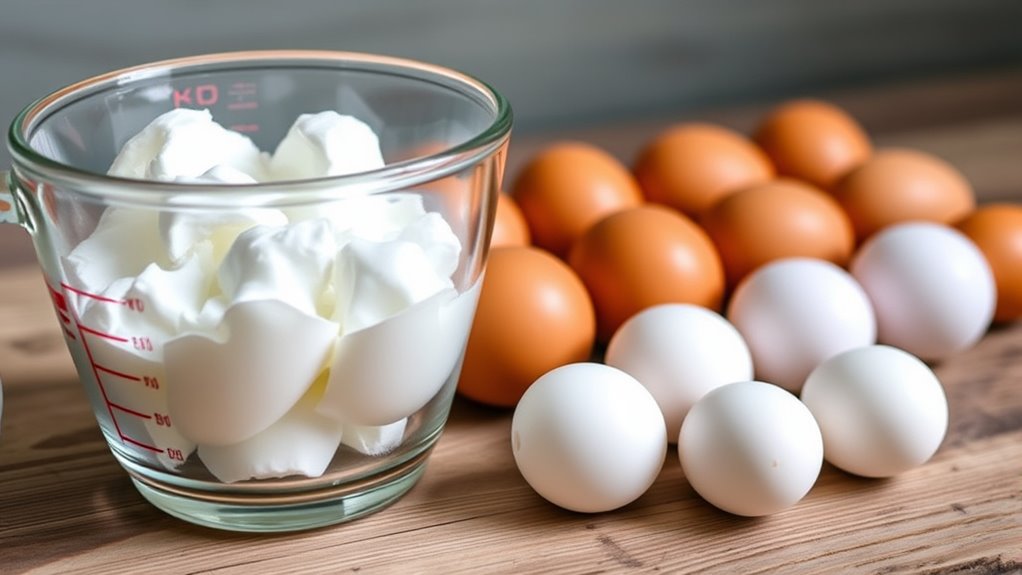
To get 12 cups of egg whites, you’ll need about 48 large eggs. Each large egg gives you roughly 2 to 2.5 tablespoons of egg whites, which is around 1 ounce.
Since 1 cup equals 8 ounces, you’ll need approximately 96 ounces of egg whites. Doing the math, 96 ounces divided by 1 ounce per egg means you need about 96 eggs.
But keep in mind, some eggs might give a bit more or less white. Rounding up to 48 eggs ensures you have enough. If your eggs are slightly smaller, you might want a few extras.
When cracking eggs, be careful to separate the whites without getting yolk in them, especially if you’re making meringues or angel food cake.
Egg White Yield: How Much Can You Expect From Different Egg Sizes
Egg white yields depend on the size of the egg, so knowing these differences can help you figure out how many eggs you’ll need for your recipe.
Large eggs usually give you about 2 to 3 tablespoons of egg whites each. Medium eggs typically yield around 2 tablespoons, while extra-large eggs can provide roughly 3 tablespoons.
Smaller eggs, like small or peewee sizes, will give you less—about 1.5 to 2 tablespoons. Keep in mind that egg size affects the total volume, so adjust the number of eggs accordingly if your recipe needs a specific amount of egg whites.
For the most accurate measurement, crack the eggs and measure the whites, especially when you’re working with different sizes.
Converting Egg Whites to Cups: The Easy Step-by-Step Method
Converting egg whites into cups is pretty simple once you know the right measurements. First, grab some fresh egg whites and a measuring cup.
Typically, one large egg white is about 2 tablespoons. To convert, pour the egg whites into the measuring cup until you reach the amount you need.
For example, if you want 1 cup of egg whites, fill the cup to the 8-tablespoon mark. If you’re using multiple eggs, just multiply the number of eggs by 2 tablespoons to get the total volume.
Use a liquid measuring cup for the best accuracy, especially with larger amounts. If you’re short on space, you can also weigh the egg whites with a kitchen scale—since 1 cup of liquid egg whites weighs roughly 8 ounces.
Estimating the Number of Eggs Needed for 12 Cups of Egg Whites
Estimating the number of eggs needed for 12 cups of egg whites is simple if you know the typical volume of one egg white. Usually, one large egg white is about 2 tablespoons or 1/8 cup.
To reach 12 cups, you’ll need:
| Egg White Volume | Number of Eggs |
|---|---|
| 1/8 cup | 1 egg |
| 1/4 cup | 2 eggs |
| 1/2 cup | 4 eggs |
| 1 cup | 8 eggs |
| 12 cups | 96 eggs |
Just multiply as needed to get an accurate estimate. Keep in mind, egg sizes can vary slightly, which might affect the total. But this table gives you a solid starting point for your calculations.
What Factors Affect Egg White Yield (Egg Size, Freshness, Etc.)
Your egg size can really impact how much egg white you get; bigger eggs usually give you more whites. Freshness also plays a role—fresher eggs tend to have firmer whites that are easier to separate and measure.
Knowing these factors helps you estimate how many eggs you’ll need for your recipe more accurately. It’s a simple way to avoid surprises when cooking or baking.
Egg Size Variations
Egg size plays a big role in how much egg white you get from each egg. Larger eggs naturally have more white than smaller ones, so you’ll need fewer big eggs to reach your target volume.
On the flip side, small eggs give less white, meaning you’ll need more to meet the same measurement. Standard sizes like medium, large, and extra-large each have different amounts of white.
Knowing the size helps you estimate accurately. If a recipe calls for a certain number of eggs, consider their sizes to get the measurements just right.
Egg size variations can cause miscalculations, especially when scaling recipes or making big batches. Always check the size label or weigh your eggs if you need exact amounts for your cooking or baking.
Freshness Impact
Freshness significantly affects how much egg white you can extract. Fresher eggs have thicker, more cohesive whites that are easier to separate and produce more volume.
As eggs age, their whites become thinner and more watery, which makes it harder to get a clean separation and reduces the total amount you can collect. Fresh eggs also tend to be of better overall quality, which impacts the yield.
Factors like storage time and temperature can speed up or slow down this deterioration. To get the most egg white, it’s best to use eggs that are as fresh as possible.
- Thicker whites in fresh eggs
- Easier separation process
- Higher total volume of whites
- Watery consistency increases over time
How to Measure Egg Whites Accurately Without a Scale
You can measure egg whites accurately using measuring cups by understanding how they fill a specific volume. Keep in mind that egg white volume varies with egg size, so larger eggs will yield more whites.
Use Measuring Cups Correctly
To measure egg whites accurately with a standard measuring cup, start by making sure the cup is clean and dry. Fill the cup slowly with egg whites, being careful not to overfill. Keep the cup on a flat, level surface and look at eye level to get an accurate reading.
For the best results, use a clear measuring cup that shows measurements clearly. If your egg whites are frothy, gently tap the cup or swirl it to settle the liquid before reading. Never guess or estimate by sight alone—accuracy really matters.
Use a transparent measuring cup for better visibility. Fill slowly to prevent spills or overfill. Keep the cup on a flat, level surface and always read measurements at eye level.
Understand Egg White Volume
Measuring egg whites by volume is simple and doesn’t need a scale—just knowing how much space a certain number of eggs usually take up. Fresh eggs typically have about 3 to 4 tablespoons of egg white each, which you can easily estimate with standard measuring cups.
When you crack an egg, the clear, viscous egg white will fill roughly half to three-quarters of a standard 1-cup measuring cup, depending on the size of the egg. To measure accurately without a scale, crack eggs into a measuring cup and check the volume of the egg whites.
This method works well if you’re aiming for a specific volume like 12 cups. It helps you figure out how many eggs you’ll need without complicated calculations.
Consider Egg Size Variations
Egg sizes can vary a lot, which affects how much egg white you get from each one. Small eggs might give you less white, while large eggs provide more. To measure egg whites accurately without a scale, you need to consider these size differences.
Use standard volume estimates for different egg sizes. For example, large eggs usually have about 1/4 cup of white. When recipes call for large eggs, adjust the number of eggs if you’re using smaller or larger ones.
Crack eggs into a measuring cup to see how much white each provides. Keep a mental or written record of how many eggs produce 1 cup of egg whites based on their size.
This method helps you get precise measurements, no matter the size of your eggs.
Can You Use Egg White Substitutes for Large Batches?
Ever wondered if egg white substitutes can handle large batches? The good news is, yes, you can use substitutes like aquafaba or commercial egg replacers for big recipes.
Aquafaba, the liquid from canned chickpeas, whips up just like egg whites and works well in many baked goods. It’s a popular vegan alternative and can be scaled easily—just measure the same volume needed.
Commercial egg replacers are designed for large batches too; just follow the package instructions. Keep in mind, substitutions might alter the final texture or flavor slightly, but they generally work well for meringues, cakes, or other recipes requiring whipped egg whites.
Tips for Efficiently Separating Eggs When Making Large Quantities
Using fresh eggs makes separating whites easier because the yolks stay intact. Chilling the eggs beforehand reduces the risk of breaking the yolk and makes handling smoother.
Make sure to use proper tools, like a clean eggshell or a separator. This helps speed up the process and keeps everything tidy.
Use Fresh Eggs
Start with fresh eggs because they’re much easier to separate than older ones. Fresh eggs have firmer whites and more intact yolks, which makes the process smoother and less messy.
When working with large quantities, using fresh eggs also reduces the chance of yolks breaking and contaminating the whites. This saves you time and effort overall.
To get the best results, pick eggs that are recent and haven’t been stored for too long. Look for eggs with clean, uncracked shells, and handle them gently to avoid breaking the yolks.
Keep eggs at room temperature, as they’re easier to separate that way. Use a clean, dry bowl to prevent slipping and spillage during the process.
Chill for Easier Separation
Chilling eggs before separating them can make the process much easier, especially when handling large quantities. Cold eggs are firmer, which helps you crack them cleanly without breaking the yolk.
When eggs are chilled, the whites are less likely to stick to the shell, reducing mess and frustration. Place eggs in the refrigerator for at least 30 minutes before cracking.
This step also minimizes the risk of yolk breaking and contaminating the whites. Cold eggs are easier to handle and less slippery, giving you better control during separation.
Keep eggs straight from the fridge and avoid letting them warm up at room temperature. Chilling simplifies the task, saves time, and results in cleaner, more efficient separation when working with large quantities.
Employ Proper Tools
Having the right tools on hand can really speed up the egg separation process, especially when you’re working with a lot of eggs. Using proper tools ensures cleaner separation and reduces mess.
A good egg separator is designed to catch yolks while letting whites pass through easily, saving you time and helping avoid broken yolks. A slotted spoon can gently lift eggshell fragments out of the whites to prevent contamination.
Using a small bowl for each egg makes it easier to catch any shells or yolk breakage before transferring the whites. Plus, a fine-mesh sieve helps strain out any remaining shell pieces or impurities.
Invest in durable, easy-to-clean tools that match your volume needs. Proper tools make large-scale egg separation faster and more efficient.
Common Mistakes When Converting Eggs to Cups (and How to Avoid Them)
Are you risking inaccuracies by converting eggs to cups without paying close attention? One common mistake is thinking all eggs are the same size, which can throw off your measurements.
Small eggs have less egg white, while large eggs contain more, so your conversion might not be accurate. Not measuring the egg whites carefully after cracking can also lead to mistakes.
Using rough estimates instead of precise measurements can affect your recipe’s outcome. To avoid these errors, always use a standard-sized egg as your reference.
Measure the egg whites carefully with a liquid measuring cup and stay consistent in your method. Double-check your measurements before adding them to your recipe to ensure accuracy and good results.
Recipes That Need 12 Cups of Egg Whites (Practical Examples)
Knowing how much egg whites you typically need for different recipes can really help you plan ahead, especially when you’re working with large amounts like 12 cups. It opens up a lot of options for baking and dessert-making.
Planning with egg whites makes large-batch baking and dessert creation much easier and more versatile.
For example, you can make meringue desserts like pavlova or big batches of Swiss meringue. Angel food cake also relies heavily on whipped egg whites for its structure.
You can also try making macarons, which require precise egg white measurements to get the perfect texture. Marshmallows are another great option, as the egg whites help create that fluffy, airy consistency.
These recipes show just how versatile egg whites are, fitting into both sweet and savory dishes. It makes preparing large quantities much easier when you need to.
How to Store Extra Egg Whites Safely for Future Use
Ever wonder the best way to keep leftover egg whites fresh for later use? To store them safely, transfer the whites into an airtight container or a clean, resealable plastic bag. Label it with the date so you can keep track of freshness.
For longer storage, freeze the egg whites in ice cube trays. Once frozen, transfer them to a freezer-safe bag. This makes portioning super easy for future recipes.
Here’s a quick look at your storage options:
| Method | Benefits |
|---|---|
| Airtight container | Keeps whites fresh in the fridge |
| Freezer bags | Great for long-term storage |
| Ice cube trays | Perfect for portion control |
| Glass jars | Eco-friendly and reusable |
| Vacuum-sealed bags | Extends shelf life |
Proper storage helps your egg whites stay fresh and ready whenever you need them.
Final Tips for Scaling up Egg White Recipes With Confidence
Once you’ve stored your egg whites properly, the next step is confidently scaling your recipes to suit your needs. To do this effectively, measure accurately and adjust ingredient proportions carefully. Egg whites are forgiving, so small tweaks usually won’t ruin your dish.
Use a kitchen scale for precise measurements when scaling up or down. Keep in mind that larger batches might need longer mixing times or slight changes in baking time.
Pay attention to the texture and consistency—if something feels off, don’t hesitate to tweak your ingredients or techniques. Keep notes of what works well so you can replicate successful results.
Finally, don’t be afraid to experiment gradually. Small adjustments can help you master perfect scaled recipes with confidence.
Frequently Asked Questions
Can Frozen Egg Whites Be Used in Place of Fresh?
Yes, you can use frozen egg whites instead of fresh. Just make sure to thaw them completely in the refrigerator before using.
Frozen egg whites might be a bit thinner, but they work well in recipes like meringues or baked goods. Stir them gently after thawing to help regain some of their original consistency.
Keep in mind, they might not whip up as stiff as fresh egg whites, but they’ll still do the job.
How Long Can I Store Leftover Egg Whites Safely?
Leftover egg whites can chill safely in your fridge for up to 4 days, like tiny, fragile secrets waiting to be revealed.
After that, they start to grow weary and risk spoiling, turning into a science experiment.
If you want to keep them longer, freeze them in airtight containers for up to 12 months.
Just remember, once thawed, use them promptly to avoid a yolk-y disaster!
Are There Nutritional Differences Between Egg Whites and Substitutes?
Yes, there are nutritional differences between egg whites and substitutes. Egg whites are low in calories, fat, and cholesterol, and they mainly provide protein.
Substitutes like egg replacers or plant-based options can vary in protein, fat, and carbs. They might also contain added ingredients or preservatives.
While egg whites offer natural nutrients, substitutes may be fortified or designed for specific dietary needs. So, it’s a good idea to check labels to understand their nutritional profiles.
What Kitchen Tools Are Best for Separating Large Egg Quantities?
Think of your kitchen tools as your culinary orchestra. To separate large egg quantities efficiently, use a dedicated egg separator or a slotted spoon, which acts like a magic wand for catching yolks.
You can also crack eggs into a bowl and carefully transfer yolks between shells, letting whites fall away. For speed, a fine-mesh sieve can do the trick, ensuring smooth separation for big batches.
How Do I Thaw Frozen Egg Whites Properly Before Use?
To thaw frozen egg whites properly, transfer them from the freezer to the refrigerator. Let them thaw gradually for about 12 to 24 hours, depending on the amount.
For quicker thawing, place the sealed container in a bowl of cold water, changing the water every 30 minutes until fully thawed.
Avoid using warm water or the microwave, as it can affect the texture and safety of the egg whites.
Conclusion
Think of measuring egg whites like filling a jar—each egg adds a piece to the puzzle. When I first tried doubling a recipe, I underestimated how many eggs I’d need, ending up with too little.
Now, knowing roughly 8 egg whites make a cup, you’ll confidently scale your recipes without waste. So, for 12 cups of egg whites, you’ll need about 96 eggs.
Remember, precision in measurement is like tuning a musical instrument—small adjustments make all the difference for perfect results.