What Are the Big Dimensions of the Kitchen in Pickleball?
If you’re new to pickleball, navigating the court can feel overwhelming at first. Many players struggle with understanding the key areas, especially the kitchen, also known as the non-volley zone.
Getting a handle on its size and rules can make a big difference in your game.
The pickleball kitchen, also called the non-volley zone, measures 7 feet by 14 feet, extending 7 feet from each side of the net across the court. You must stay outside this zone when volleying unless the ball has bounced.
Marked with 2-inch wide lines, its size influences your movement, positioning, and strategy during play. Understanding these dimensions helps you avoid faults and play more effectively—keep going to explore how to master the kitchen’s full rules and tips.
Key Takeaways
- The pickleball kitchen, also called the non-volley zone, extends 7 feet from each side of the net.
- This means the kitchen is 14 feet long along the court’s width.
- Its width stays consistent at 20 feet across all official courts.
- You’ll usually see markings that are two parallel lines, 7 feet from the net, running across the court.
- Getting the right dimensions for the kitchen is really important. It helps keep the game fair and strategic.
- Plus, proper measurements help prevent faults during matches.
What Is the Exact Size of the Pickleball Kitchen?
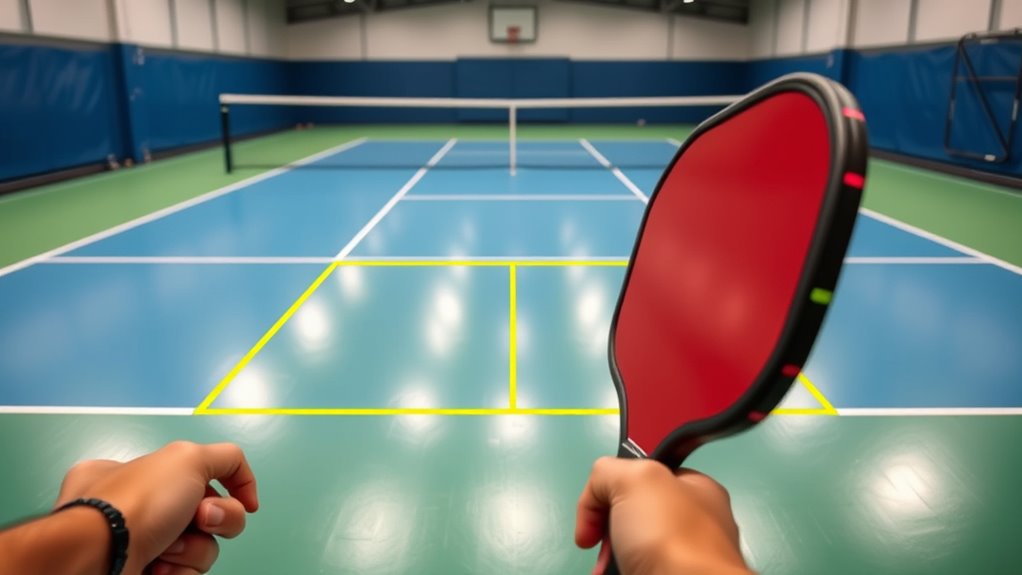
The pickleball kitchen, also called the non-volley zone, measures 7 feet by 14 feet. This area extends from the net on each side, creating a space players need to stay out of when volleying the ball.
Its size is the same across all official courts, which helps ensure fair play. When you’re near the net, being aware of these boundaries is key to avoiding faults.
The width of 7 feet gives enough room for strategic shots while keeping safety in mind. The 14-foot length helps balance offensive and defensive plays at the net.
Knowing the exact dimensions helps you position yourself properly and develop better strategies. It also ensures you follow the rules accurately during your matches.
How Are the Kitchen Lines Marked on a Court?
Marking the kitchen lines on a pickleball court involves drawing two parallel lines that run across the width of the court, 7 feet from the net on each side. Use a measuring tape to mark 7 feet from the net along both sidelines.
Next, draw straight lines across the court, connecting these points. Make sure the lines are clearly visible and consistent in width, usually 2 inches, using a durable marking material suitable for indoor or outdoor surfaces.
Draw clear, 2-inch wide lines across the court with durable markings for consistent, visible non-volley zones.
These lines define the non-volley zone, so accuracy is key for fair play. Double-check your measurements to avoid discrepancies during matches.
Properly marked kitchen lines help players stay within the rules and make quick, accurate decisions during gameplay.
What Are the Official Measurements for the Kitchen?
The official measurements for the kitchen, also known as the non-volley zone, specify that it extends 7 feet from the net on both sides of the court.
This zone is marked clearly with lines parallel to the net, creating a rectangular area. It runs the full width of the court, which is 20 feet.
The 7-foot boundary is consistent across all official courts, ensuring standardization. When you’re playing, stay aware of these measurements to avoid stepping into the kitchen during volleys, as it’s a violation.
The measurements are designed to promote fair play and safety, limiting aggressive smashes near the net.
Understanding these precise dimensions helps you position yourself correctly and strategize your shots effectively during the game.
Why Do Kitchen Dimensions Matter in Pickleball Strategy?
Because the kitchen’s dimensions are precisely defined, they play a crucial role in shaping your strategy during a pickleball match. Knowing its size helps you decide when to stay back or move in aggressively.
For example:
- Control and Placement: Smaller kitchens limit your options, so you need to be very precise with your shots and where you place them.
- Defensive Positioning: The dimensions influence how close you should be to effectively block your opponents’ shots.
- Serve and Return Tactics: Understanding the size guides you in choosing effective serve depths and return angles, making your shots less predictable.
How Does Kitchen Size Affect Your Play and Movement?
A bigger kitchen means you’ve got more space to move and react, so you’re less likely to feel cramped.
It also gives you more shot options and angles, making your rallies more flexible.
Plus, with extra room, you can stay better positioned defensively and respond quickly to your opponent’s shots.
Movement Freedom and Space
When the kitchen area in pickleball is spacious, you have more freedom to move quickly and confidently around the net. This extra space helps you:
- React faster to shots, cutting down hesitation and boosting your response time.
- Shift your position smoothly, giving you better control over where you’re standing.
- Make quick side-to-side movements without feeling cramped or restricted.
A larger kitchen encourages more active and dynamic play, making it easier to approach the net with confidence and recover afterward. It also lowers the chances of accidental foot faults caused by tight spaces. With plenty of room, you can better anticipate your opponents’ shots and stay balanced during quick changes in direction. Overall, having more space improves your mobility, making your gameplay smoother and more effective.
Shot Selection Flexibility
A larger kitchen gives you more options for shot selection, letting you adapt your strategy based on your position and the flow of the game. With extra space, you can hit softer dinks, aggressive drives, or quick volleys without feeling cramped.
This flexibility helps you surprise your opponent and change your tactics on the fly. It’s all about making your game more dynamic and less predictable.
| Shot Type | Advantage in Larger Kitchen |
|---|---|
| Dinks | Safer, controlled placement |
| Drives | More aggressive power shots |
| Volleys | Faster reactions, less restriction |
| Lob | Better angles, safer clearance |
Having more space encourages creative shot choices, making your game more exciting and unpredictable.
Defensive Positioning Ease
Larger kitchens make it easier to stay in a strong defensive position because you have more space to move quickly and adjust your stance. With extra room, you can keep centered and react faster to your opponent’s shots, which helps prevent you from getting caught out of position.
Here are three ways a bigger kitchen benefits your defense:
- Improved mobility: More room means you can cover ground more efficiently, making it easier to intercept shots.
- Better stance adjustments: You can shift your positioning smoothly without feeling cramped.
- Enhanced anticipation: Having extra space helps you read your opponent’s plays better and gives you more time to react.
Common Mistakes When Playing Near the Kitchen
Many players make mistakes when playing near the kitchen, like standing too close or moving during a point. These small errors can really cost you.
Ignoring the non-volley zone rules can lead to penalties and missed chances to score.
Being aware of these common mistakes helps you stay focused and play more strategically.
Standing Too Close
Standing too close to the kitchen line is a common mistake that can easily lead to faults or penalties. When you’re too close, you risk stepping into the non-volley zone during volleys, which results in an immediate fault.
To avoid this, keep these points in mind:
- Maintain at least 7 feet from the net during rallies to stay outside the non-volley zone.
- Watch your foot placement to make sure you don’t step into the kitchen when volleying.
- Practice proper positioning to stay behind the kitchen line without sacrificing your reach or shot angle.
Ignoring Non-Volley Zone
Ignoring the non-volley zone, or kitchen, is a common mistake players make when they get too focused on their shots or positioning.
When you don’t respect the kitchen, you risk violating the rules by volleying the ball while standing inside it. This can lead to point penalties and give your opponents an easy advantage.
Staying aware of the kitchen’s boundaries is especially important during quick exchanges near the net. Many players forget to step back before volleying or mistake the line for a safe zone.
Remember, you must let the ball bounce if you’re in the kitchen or wait until you’re outside it to make a volley. Ignoring this rule disrupts gameplay and can cost you points.
Always keep the non-volley zone in mind during every rally.
Moving During Play
Moving abruptly or excessively near the kitchen can lead to mistakes and cost you points. Quick, uncontrolled movements might cause you to step into the non-volley zone or break the rules.
To avoid this, focus on controlled, deliberate movements. Here are three common mistakes to watch out for:
- Lunging or rushing to reach the ball, which can cause you to step into the kitchen too early.
- Sliding or gliding across the court, risking losing balance and foot faults.
- Fidgeting or shifting your position too often, disrupting your stance and timing.
How Do You Properly Navigate the Kitchen During a Match?
Have you ever wondered how to navigate the kitchen area effectively during a pickleball match? To do this properly, stay aware of your position relative to the non-volley zone line.
When approaching the kitchen, move cautiously, avoiding stepping inside unless you’re executing a volley or following a specific rule. Keep your feet behind the line until you’re ready to hit the ball, and always watch your opponents’ movements to anticipate their shots.
If you’re at the net, be mindful of your foot placement to prevent violations. Use small, controlled steps to adjust your position without crossing the line unintentionally. Staying alert and maintaining good footwork helps you stay within the rules while positioning yourself advantageously for each shot.
Can Kitchen Size Vary Based on Court Type or Level?
You might notice that the kitchen size can change depending on the court type or skill level. Different courts, like indoor or outdoor, often have slight variations in dimensions.
Players at higher levels may face stricter or more standardized measurements. These differences can influence how you approach your game and strategize around the kitchen area.
Court Type Influence
Does the size of the kitchen, or “kitchen,” vary depending on the court type or level of play? Yes, it can. Different court surfaces and setups influence how the kitchen is marked and used.
For example, indoor courts usually follow standard dimensions, but some might have slight variations for recreational play. Outdoor courts sometimes feature differences to fit space constraints or custom designs.
Tournament courts tend to stick closely to official standards, making sure the kitchen size is consistent across competitions. These differences can affect gameplay, especially for advanced players.
While the core dimensions stay mostly the same, subtle variations based on court type can influence strategies and court awareness.
Skill Level Adjustments
While court type influences the overall markings and setup of the kitchen, skill level also affects how the kitchen is used during play. Beginners tend to stick to standard dimensions, focusing on consistency and control.
As players improve, they might experiment with positioning and shot placement around the kitchen to gain an edge. Although the official size stays the same, higher-level players use the space more strategically.
They may move closer or farther from the net to influence shots or defend better. Less experienced players usually stay closer to the kitchen to reduce risk and keep things simple.
Ultimately, even though the dimensions are fixed, players’ skill levels shape how they utilize this space. This influences their gameplay style and tactics.
Safety Tips for Playing Near the Kitchen
Playing near the kitchen needs extra caution since it’s a busy spot where players often move quickly and unpredictably.
To stay safe, keep these tips in mind:
- Stay alert: Watch for opponents’ shots and movements so you can avoid collisions or accidental contact.
- Maintain control: Don’t rush your shots near the kitchen. Take your time to ensure safe, accurate hits.
- Respect the line: Always stay outside the kitchen’s non-volley zone and be mindful of your foot placement to avoid stepping in during play.
How to Use Kitchen Dimensions to Improve Your Game
Understanding the exact dimensions of the kitchen can give you a real edge in your game. Knowing the size helps you position yourself better, whether you’re at the net or preparing to receive a shot.
Use the 7-foot non-volley zone to stay back and avoid foot faults, or step closer strategically to intercept shots. When you understand the 14-foot width, you can better judge angles for dinks and volleys, maximizing control.
Practice hitting shots that stay within the kitchen boundaries to improve accuracy under pressure. Recognizing the space allows you to anticipate opponents’ moves and react faster.
What Are the Rules for Kitchen Violations and Foot Faults?
Knowing the rules for kitchen violations and foot faults is key to avoiding penalties and keeping your game fair. If you step into the kitchen or break foot fault rules, you’ll lose your rally.
You can’t step into the kitchen or its non-volley zone when hitting the ball unless the ball bounces first. This means you need to be careful when approaching the net.
While volleying, your feet must stay outside the kitchen boundary. Any part touching the line counts as inside, so watch your foot placement.
After volleying, you must exit the kitchen immediately to avoid a fault. Staying aware of where your feet are helps you play clean and fair.
Mastering these rules keeps your game smooth and penalty-free. Being mindful of your foot position and the kitchen boundaries is essential for good play.
Frequently Asked Questions
How Do Official Pickleball Court Dimensions Differ Worldwide?
You’ll find that official pickleball court dimensions are pretty consistent worldwide, measuring 20 feet wide by 44 feet long for both singles and doubles matches.
The main differences come in some local variations for recreational courts or non-regulation setups. But internationally, the International Federation of Pickleball (IFP) and USA Pickleball set these standard dimensions.
Always double-check local rules if you’re playing in a different country or setting.
Are There Different Kitchen Sizes for Beginner and Professional Courts?
No, there aren’t different kitchen sizes for beginner and professional courts. The kitchen, or non-volley zone, is always a standard 7 feet from the net on each side.
This size stays the same regardless of skill level. It helps keep the game fair and consistent for everyone.
Whether you’re just starting out or playing professionally, you’ll find the kitchen dimensions don’t change. This ensures rules are clear and the game stays fair across all courts.
Does Court Surface Type Influence Kitchen Measurements?
No, court surface type doesn’t influence kitchen measurements in pickleball. The kitchen, also called the non-volley zone, has standard dimensions of 14 feet by 20 feet.
These measurements are the same whether you’re playing on concrete, asphalt, or indoor flooring. They stay consistent to keep the game fair and standardized everywhere.
Whether you’re a beginner or a pro, everyone knows exactly where the kitchen boundaries are during the game.
Can Custom Court Designs Alter the Standard Kitchen Size?
Yes, custom court designs can change the standard kitchen size. You might notice differences in the kitchen’s width, length, or shape depending on your layout preferences.
These changes can be made to make better use of space, improve gameplay, or match your aesthetic choices. While the main purpose stays the same, you have the flexibility to adjust dimensions within accepted guidelines.
This way, your court can be tailored to your needs without sacrificing safety or tournament standards.
How Do Tournament Regulations Specify Kitchen Size Variations?
Tournament regulations typically specify the kitchen as a 14-foot by 20-foot area, but some variations can occur based on the event.
You’ll want to check the specific rules of each tournament, as some might allow slight adjustments for court space or facility constraints.
Always confirm with the tournament director or official rulebook before setting up your court to ensure compliance and fair play.
Conclusion
Understanding the big dimensions of the pickleball kitchen is like having a secret weapon in your game arsenal. When you know the exact size, how the lines are marked, and the rules, you gain an edge on the court.
Remember, mastering the kitchen isn’t just about size. It’s about using that knowledge to outsmart your opponent and dance around the net with confidence.
The kitchen measures 7 feet from the net into the court on each side, and it’s crucial to know these dimensions. Knowing the size helps you stay within the rules and play smarter.
Lines are marked clearly, so understanding where the kitchen begins and ends can make or break your shot. It’s all about knowing where you can and can’t stand or hit from.
Getting familiar with these big dimensions of the pickleball kitchen gives you an advantage. Stay sharp, practice your placements, and let your game flourish like a well-tuned instrument.